RESEARCH REVISITED
MY ROLE
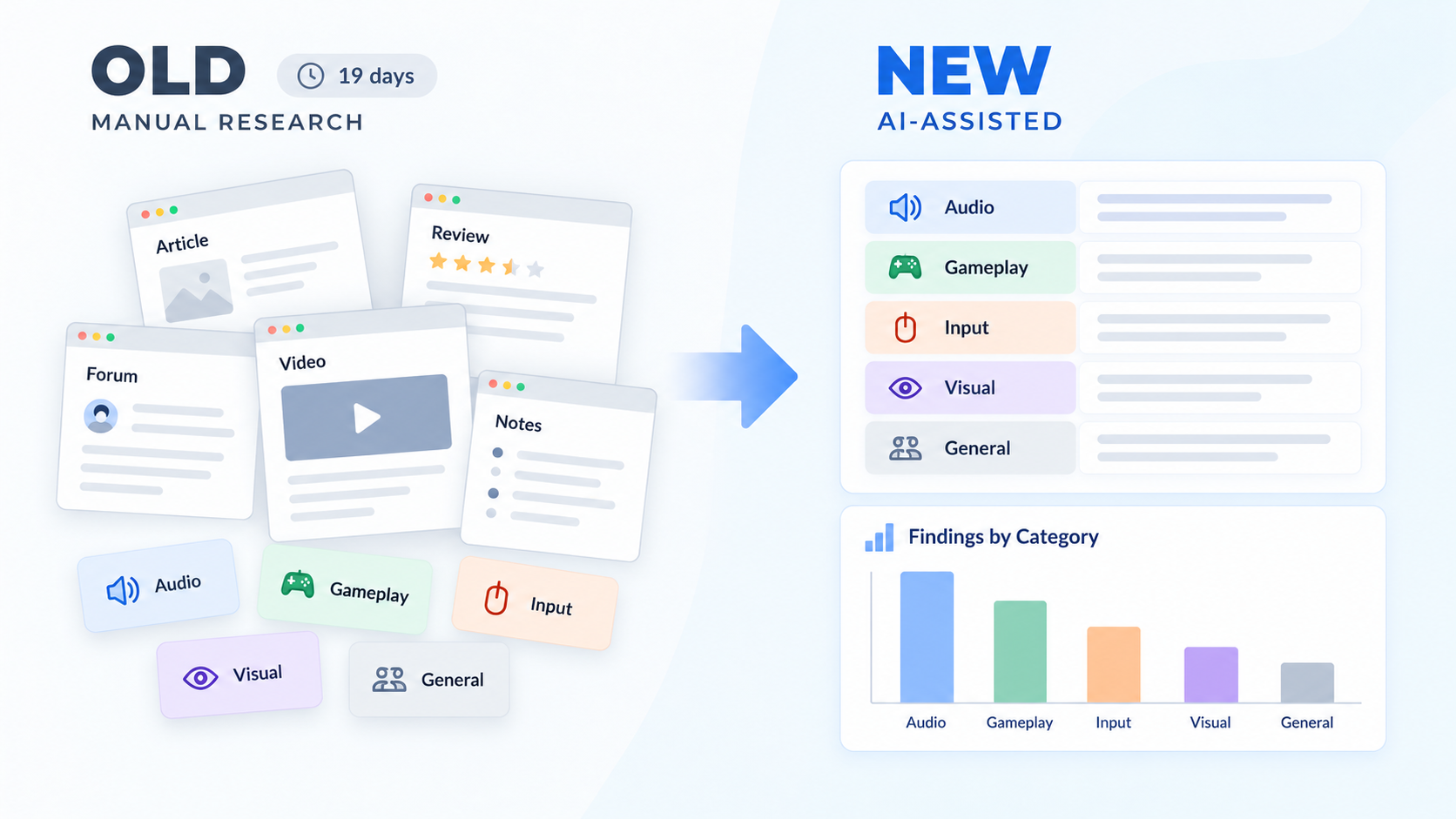
I guided the new research, reviewed the findings, and decided what was actually useful. Parts of the original research can be seen here.
AI’S ROLE
My bot helped with searching, summarizing, organizing feedback, and spotting patterns across sources.
THE EXPERIMENT
Redo the same research with AI and see how much faster the process could be and what other materials could be produced.
Old Workflow vs AI-Assisted
Original Project
- Manually searched articles, reviews, forums and player comments
- Read through sources and pulled out useful feedback by hand
- Manually grouped findings into accessibility categories
- Compared Halo Infinite pain points against other games
- Turned the research into recommendations and presentation materials
AI-Assisted Version
- Helped find relevant sources much faster
- Summarized sources and pulled out relevant accessibility feedback
- Helped categorize findings and identify recurring patterns
- Connected problem areas to examples from other games
- Helped create additional charts, visuals and presentation content
What AI Couldn't Do
- Capture gameplay footage directly from the games
- Record feature demonstrations
- Create in-game screenshots showing specific features
- Personally experience how the features felt during play
- Capture GIFs, videos and screenshots and organize them into the Confluence reference page
Halo infinite Audit
As part of the Accessibility Research project, I had looked into sentiment on Halo Infinite’s Accessibility features for opportunities for improvement.
Original Process
I manually searched through reviews, accessibility articles, forums and player comments to find recurring complaints about Halo Infinite’s accessibility.
AI-Assisted Process
AI helped search across the same kinds of sources, pull out the relevant negative feedback, and organize repeated issues into themes for review.
Visual
Original Findings
- Colorblindness options did not help everyone with colorblindness
- Low contrast made text, UI and important information harder to see
- Text, icons and UI elements were too small
- Subtitle customization was too limited
- Some visual effects contributed to motion sickness
AI-Assisted Findings
- HUD text, prompts and waypoints remained difficult to read even with scaling options. Source: Can I Play That
- Glow, blur and low-contrast UI styling reduced visual clarity. Source: Can I Play That
- Players continued requesting more colorblind customization after launch. Source: Halo Waypoint
- Subtitle sizing could still be too small during fast combat. Source: Can I Play That
Input
Original Findings
- Some input requirements were physically awkward
- Repeated actions could cause physical strain
- There were limited options for reducing fatigue
- Controller remapping was limited
- Keyboard mapping and menu navigation caused friction
AI-Assisted Findings
- Remapping did not eliminate every difficult stick-click requirement. Source: PC Gamer
- Toggle alternatives could still create difficulty during demanding gameplay. Source: PC Gamer
- Players requested additional movement accessibility, including auto-sprint. Source: Halo Waypoint
Audio
Original Findings
- Text-to-Speech and screen narration did not always work as expected
- Some UI was not narrated
- Important audio cues were missing
- Players had difficulty distinguishing what sounds represented
- Audio customization lacked granularity
AI-Assisted Findings
- Narration struggled to keep up with fast gameplay and interaction prompts. Source: Can I Play That
- Directional and targeting audio cues were identified as missing. Source: Can I Play That
- Players requested audio visualization so critical information would not rely on hearing. Source: Halo Waypoint
- Text-to-Speech and UI narration issues were documented after launch. Source: Halo Support
Gameplay
Original Findings
- Difficulty could not be adjusted during gameplay
- Some encounters required very precise situational reflexes
AI-Assisted Findings
- Fast combat and constant switching between weapons, grenades and equipment created a high physical workload. Source: PC Gamer
- Open-world traversal combined with fast combat was described as tiring. Source: Can I Play That
General
Original Findings
- Accessibility changes could not be previewed before committing
- Players had to leave the menu to test settings
- Some setting descriptions were unclear
AI-Assisted Findings
- Some UI and subtitle changes could not be previewed before gameplay. Source: Can I Play That
- Having many accessibility settings did not necessarily mean the underlying barrier was removed. Sources: Can I Play That · PC Gamer
Accessibility in the shooter genre
Original Process
- Searched articles and accessibility lists for shooter games worth investigating
- Read specialist reviews and player feedback to see what people actually praised
- Built a shortlist of games that repeatedly surfaced as strong examples
- Looked for features that genuinely helped players rather than simply checking an accessibility box
- Only then launched the games to inspect and capture those features firsthand
AI-Assisted Process
- Searched across accessibility reviews, articles, awards, lists and player discussions at once
- Pulled out games that repeatedly appeared in positive accessibility coverage
- Identified which specific features were being praised and why
- Grouped recurring patterns across titles before any hands-on game capture
- Produced a much larger starting shortlist that could immediately be validated in-game
Fortnite
Original Findings
- Visualization of sound effects
- Subtitles
- HUD scaling
- Keyboard and controller remapping
AI-Assisted Findings
- Visualized sound effects repeatedly surfaced as a standout accessibility feature. Source: Can I Play That
- Subtitle customization and visual communication of gameplay information were also praised. Source: Can I Play That
Gears 5
Original Findings
- Content of subtitles
- Sound visualization
- Keyboard and controller remapping
AI-Assisted Findings
- Rich subtitles surfaced repeatedly, including speaker identification and information beyond spoken dialogue. Source: Can I Play That
- Sound visualization and flexible input options were also highlighted. Source: Can I Play That
Far Cry 6
Original Findings
- Accessibility presets
AI-Assisted Findings
- Accessibility presets surfaced as one of the game's most notable approaches, giving players starting configurations for different accessibility needs. Source: Can I Play That
Guardians of the Galaxy
Original Findings
- Content of captions
- Subtitles
- Difficulty settings
AI-Assisted Findings
- Granular difficulty settings surfaced as a particularly strong design decision, allowing individual parts of difficulty to be adjusted separately. Source: Can I Play That
- Subtitle and caption customization were also positively highlighted. Source: Can I Play That
Watch Dogs: Legion
Original Findings
- Content of captions and subtitles
- Subtitle and caption presentation
AI-Assisted Findings
- Gameplay captions surfaced as a strength because they communicate environmental and directional information in addition to dialogue. Source: Can I Play That
- Caption presentation and speaker information were also highlighted as useful. Source: Can I Play That
What ai helped me add
Once the original research had been recreated, I used the same findings to see what else AI could help me make — from clearer charts and comparisons to more polished recommendations.
Games Identified for Research
One of the biggest differences was how quickly AI could surface a larger pool of promising games before any hands-on investigation began.
Accessibility Themes That Kept Appearing
I also used AI to organize the highlighted features across the new game shortlist and look for broader patterns in what players and accessibility reviewers were praising.
Problem
Important gameplay sounds were not always understandable or usable without relying on audio.
Pattern
Gears 5, Fortnite and Watch Dogs: Legion all communicated sound through captions, directionality or visual indicators.
Opportunity
Present critical gameplay information through multiple sensory channels instead of depending on sound alone.
Problem
Some accessibility settings existed, but players still struggled to find or configure combinations that worked for them.
Pattern
Far Cry 6 used accessibility presets as starting points while still allowing individual settings to be customized.
Opportunity
Use presets to reduce setup effort while preserving granular control for players who need it.
Problem
Fast combat and repeated inputs could create physical strain or require more precise reactions than some players could manage.
Pattern
Games like Guardians of the Galaxy and newer shooters separate difficulty, timing and assistance settings instead of relying on one global difficulty level.
Opportunity
Let players reduce the specific barrier they are experiencing without lowering every aspect of the game.
Problem
Players could not always tell whether accessibility changes would help until they left the settings menu and tested them.
Pattern
Stronger accessibility implementations make settings easier to understand, preview and adjust in context.
Opportunity
Show previews and clearer explanations so players can understand a setting before committing to it.